Thailand 100 Baht Polymer Banknote (2025): Security Features, Design, and an Unusual Two-Signature Phenomenon
In November 2025, Thailand officially introduced a new 100 Thai Baht polymer banknote into circulation. While at first glance it may seem like a routine upgrade, this issue has quickly become one of the most discussed modern Thai banknotes among collectors worldwide.
The reason is not only its advanced polymer security features, but also a rare numismatic situation: within just a few months after release, the same banknote already exists with two official signature varieties — and was actively traded internationally before it became common in local circulation.
As a banknote collector living in Thailand, I was able to observe this phenomenon directly from inside the country.
General Information – 100 Baht Polymer Banknote (2025)
- Denomination: 100 Thai Baht
- Substrate: Polymer
- Official issue date: November 2025
- Legal tender: Yes
- Purpose: Daily circulation and long-term replacement of paper notes
Polymer banknotes are known for their durability, resistance to moisture, longer lifespan, and significantly improved protection against counterfeiting.
Banknote Design
Front (Obverse)
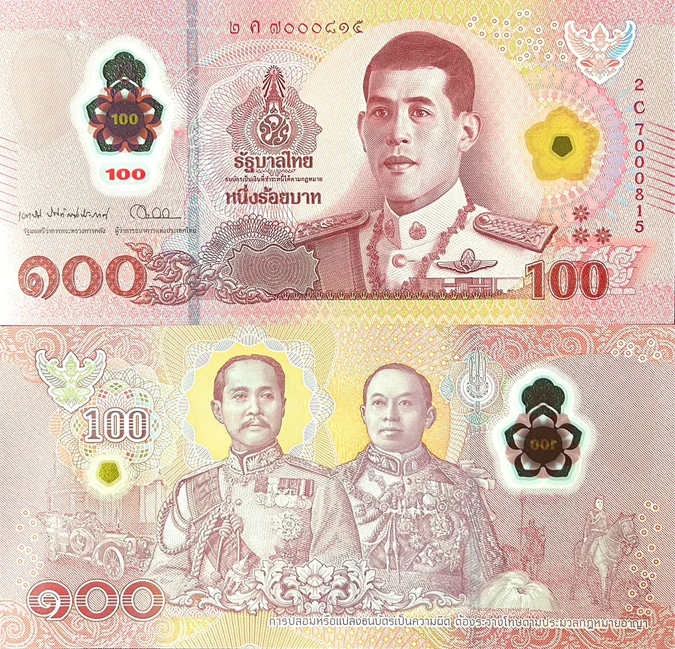
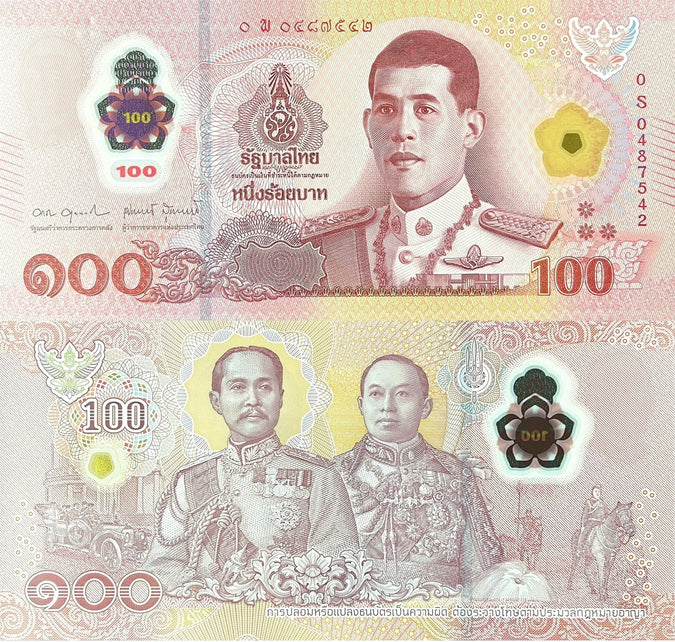
The obverse features His Majesty King Maha Vajiralongkorn Phra Vajiraklaochaoyuhua (King Rama X) in the Royal Thai Air Force uniform. The portrait is finely detailed and surrounded by tactile elements designed to assist the visually impaired.
Back (Reverse)
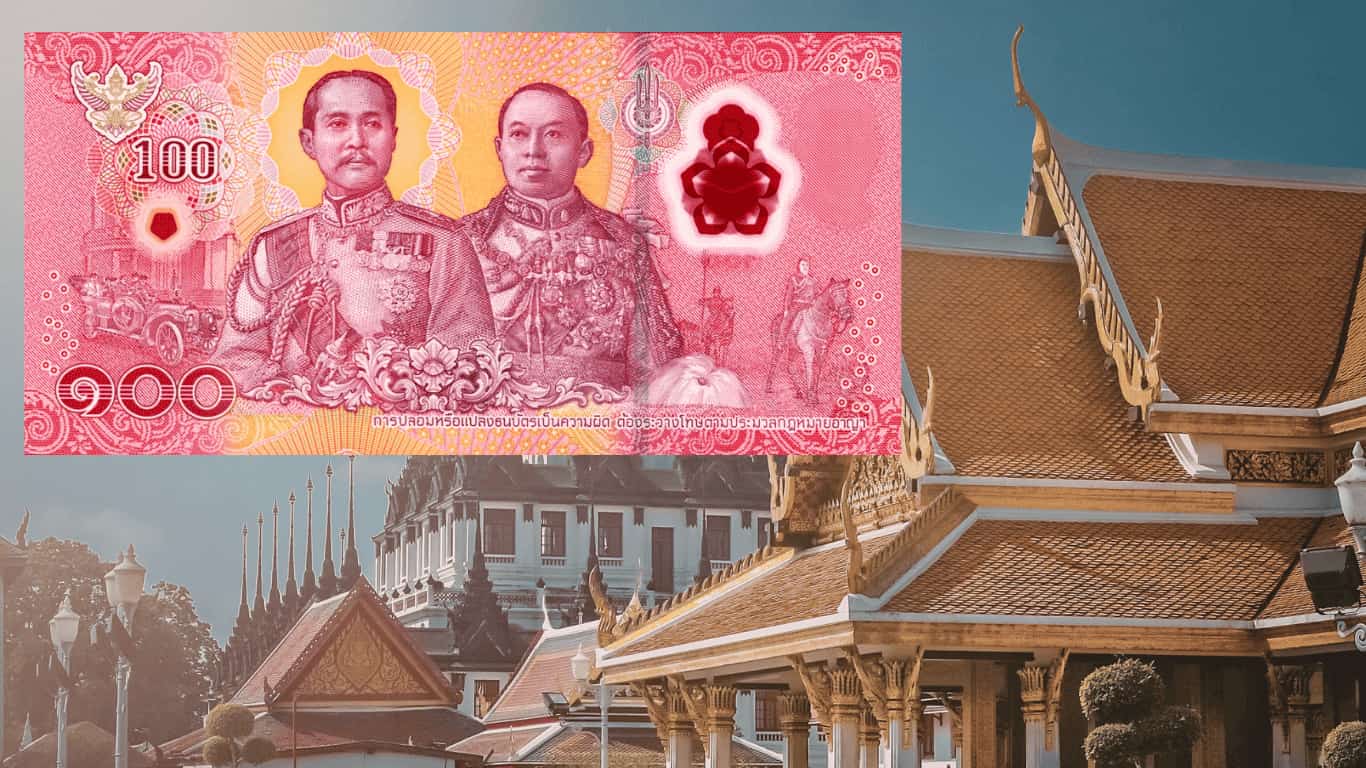
The reverse side depicts:
- His Majesty King Chulalongkorn (King Rama V)
- His Majesty King Vajiravudh (King Rama VI)
This composition highlights continuity within the Thai monarchy and honors the reformist era of modern Thailand.
Polymer Substrate
The banknote is produced on a special polymer substrate with a coated surface, offering:
- High resistance to wear and humidity
- Longer circulation life than paper banknotes
- Enhanced anti-counterfeiting capabilities
- Superior print clarity over time
Security Features and Tactile Elements
The 2025 polymer 100 baht banknote incorporates a full range of modern security technologies, including:
Raised Print
Easily felt around:
- The King’s portrait
- The royal emblem
- Denomination in words and numerals
Embossed Number
An embossed “100” is located in the upper clear window and can be identified by touch.
Raised Lines
Six transparent diagonal raised lines appear on both the left and right edges of the obverse.
Tactile Marks and Emboss
Three tactile marks shaped like flowers represent the Braille letter “H”, symbolizing the denomination 100.
Clear Windows
- Visible from both sides
- The lower window displays a color-shifting effect
Gold Metallic Window
A transparent gold pentagon, printed with metallic ink in the shape of a five-petal flower, appears to the right of the King’s portrait and is visible from both sides.
Shadow Image
The King’s portrait appears clearly when the banknote is viewed against the light.
Magnetic Printed Thread
Contains numerals and letters indicating the denomination, visible when held to the light.
See-Through Register
A perfectly aligned front-and-back design visible when viewed through transmitted light.
Latent Numbers
Hidden Arabic numerals become visible when the note is viewed at a shallow angle from the lower left or right.
UV Features
Under ultraviolet light, the following become visible:
- Denomination numerals
- Serial numbers
- Embedded fibers glowing in yellow, red, and blue
A Rare Case: Two Official Signature Varieties Within Months
What makes this banknote especially interesting for collectors is the speed at which signature varieties appeared.
Although the polymer 100 baht banknote was released only in November 2025, by early 2026 it was already confirmed with two official signature combinations:
Known signature varieties:
- Pichai Chunhavajira (PC) – Minister of Finance Sethaput Suthiwartnarueput (SS) – Governor of the Bank of Thailand
- Ekniti Nitithanprapas (EN) – Minister of Finance Vitai Ratanakorn (VR) – Governor of the Bank of Thailand
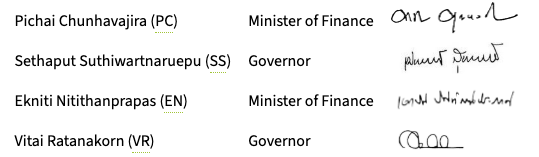
This means that within approximately three months, a brand-new polymer banknote intended for mass circulation already exists in two distinct official varieties.
Such situations are uncommon in modern banknote issues and are typically of strong interest to collectors and researchers.
A Collector’s Observation: Issued, but Not Found in Circulation
Here is an especially telling and rarely documented fact.
Despite the official release in November 2025, the polymer 100 baht banknote was practically impossible to find in everyday circulation in Thailand for several months. As a collector living in Thailand and regularly using cash, I did not encounter this banknote in circulation until February 2026 — not in shops, not in change, and not through normal daily transactions.
At the same time, the banknote was already widely available on international markets:
- Numismatic platforms
- Dealer inventories
- Private collector sales in Europe, the USA, and Asia
This strongly suggests that early quantities were rapidly purchased by dealers and collectors and exported abroad. The reasons are clear:
- A new polymer issue
- High international collector demand
- Early print runs
- And the unexpected appearance of two signature varieties
In effect, the banknote became a collector’s item before it truly entered mass domestic circulation.
Why This Matters to Collectors
For collectors of modern Thai banknotes, this issue represents:
- Early formation of recognized sub-varieties
- Strong international demand
- Limited availability of early UNC examples
- Long-term potential for structured collecting by signature type
Cases where a newly issued banknote is exported globally faster than it circulates domestically are rare and usually associated with particularly significant issues.
Conclusion
The Thailand 100 Baht polymer banknote (2025) is more than just a modern means of payment. It is a real-time example of how technology, administration, and collector demand intersect to create numismatic history almost immediately.
Released in November 2025, yet already existing in two official signature varieties and heavily traded internationally before appearing in local circulation, this banknote has firmly secured its place as a key modern Thai issue.
For anyone collecting contemporary Thai banknotes, this is a release that deserves attention now — not later.